VSP Vision Care
People working in a greenhouse looking at a digital device

Impacts Without Boundaries: Screen-related Eye Issues Have Left the Building


From the shop floor to the top floor, screens have become a necessity for getting the job done. Whether reviewing global dashboards, monitoring line equipment, ringing up groceries, or shaping young minds, screens are ever present and it’s resulting in unprecedented levels of exposure.


Collectively, desk-based and non-desk-based workers log more than 93 hours of screen time every week. All that exposure is taking a toll personally and professionally.1 In this article, we’ll examine some of the key issues related to excessive screen time in the workplace:


Let’s begin by looking at how much time employees are spending on screens.
Nearing the century mark


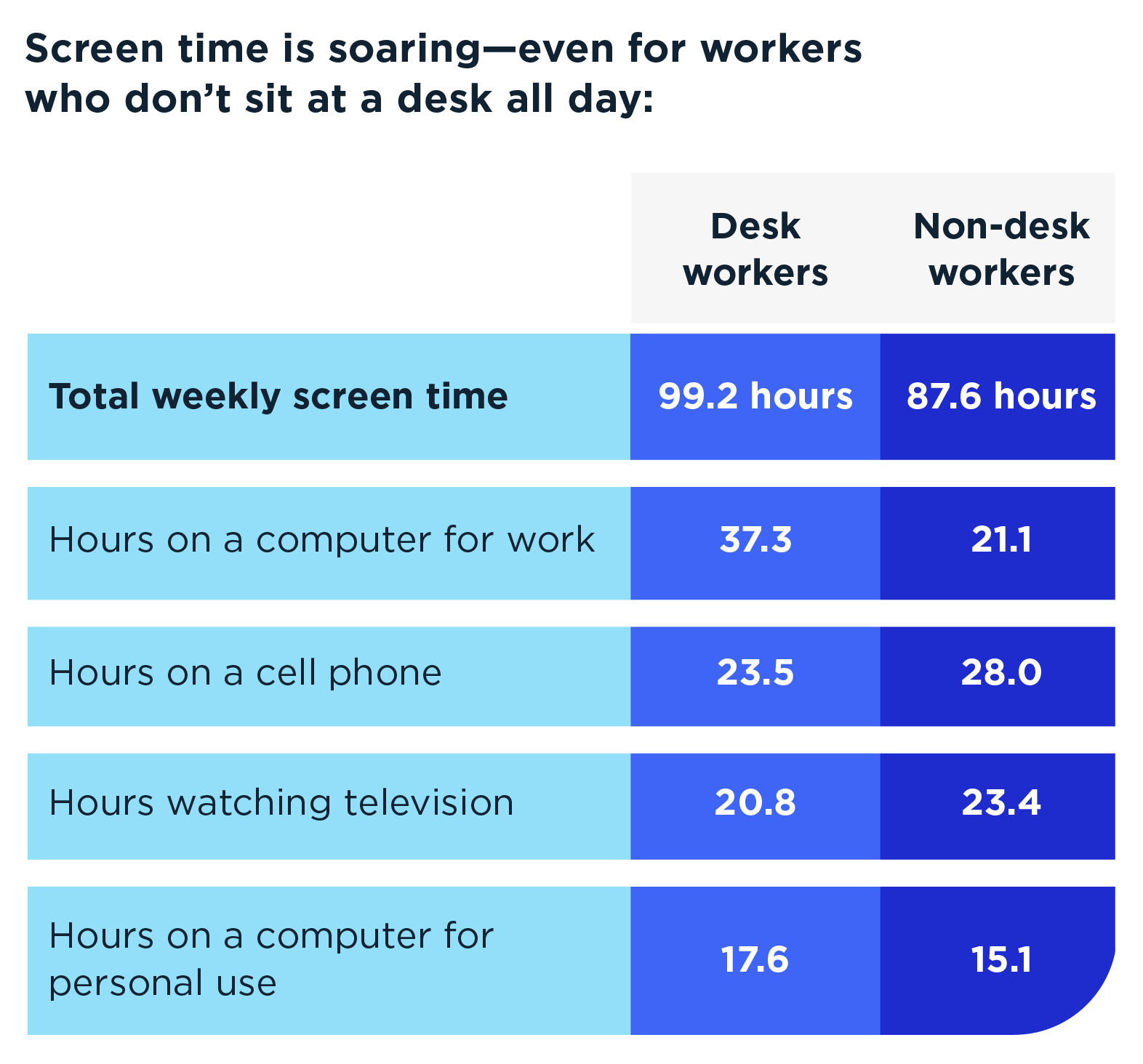
The VSP® Vision Care 2026 Workplace Vision Health Report reveals that screen time has climbed steadily for the past three years. Desk workers now average 99.2 hours of total weekly screen time, up from 97 hours last year and 96.1 the year before. Surprisingly, their non-desk counterparts aren’t far behind, logging 87.6 weekly hours.2


Non-desk workers say they spend 78% of their waking hours on screens, and astoundingly, desk workers say their eyes are focused on screens 93% of the time they’re awake.3


If it seems unreal that someone could spend almost an entire day looking at a screen, think about a day in the life of a typical person. From the moment we wake to the time we sleep, we work, learn, play, socialize, read, and stream through some kind of device. You’re doing it right now.


If you tracked your own daily activities, you might be surprised by how many of them revolve around a screen.

Workplace Vision Health Report graphic comparing screen time of desk workers versus non desk workers
persona holding tablet

Get a Blueprint for Building an Eye-friendly Workplace.

Download the VSP® Vision Care 2026 Workplace Vision Health Report today!


Teacher and student working on a tablet computer

Infiltrating untraditional occupations

The digital transformation of our world has introduced screens into occupations once considered free from the need for technology. And while the injection of technology brings with it a long list of benefits, it also extends the reach of screen-related eye issues to more workers, including:

  • Teachers
  • Medical professionals
  • Retail workers
  • Construction workers
  • Machine operators
  • And many more!

What are the impacts of all this exposure?


Prolonged exposure to screens contributes to a list of symptoms the American Optometric Association refers to as digital eye strain.4 According to the Workplace Vision Health Report, 71% of desk workers and 59% of non-desk workers say they experience digital eye strain symptoms, including:5


  • Dry or irritated eyes
  • Headaches
  • Blurred or double vision
  • General eye discomfort

But the impacts don’t stop at the eyes. Survey participants also say they encounter difficulties with the following:6


  • Mood
  • Social engagement
  • Well-being
  • Professional performance

In short, digital eye strain isn’t just uncomfortable, it reshapes how people feel, live, and perform.

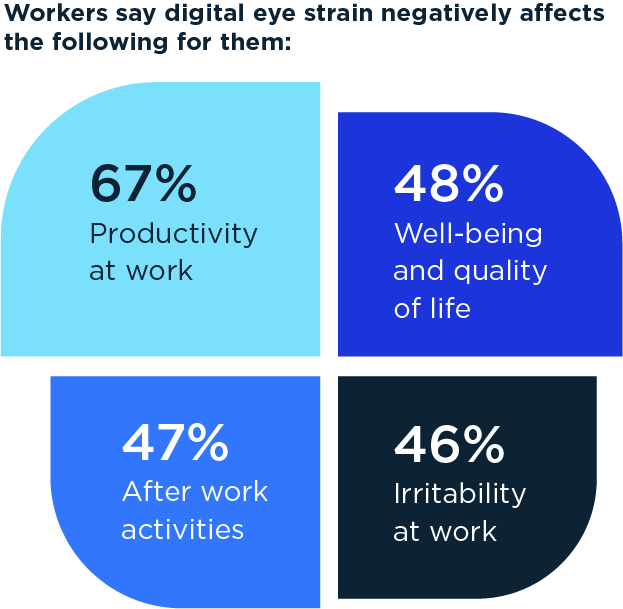
Graphic showing how employees say digital eye strain negatively affects productivity, mood, social life, and well-being

Organizational implications


When employees are hindered by daily discomfort stemming from screen exposure, they can't perform at their peak. Focus, attendance, output, and work quality all suffer.7 That's not only bad for employee satisfaction and workplace culture, it's bad for business.

For example, 67% of all workers surveyed say digital eye strain reduces their productivity by 7.4 hours per week. One in four employees report taking time off work due to digital eye strain impacts, with employees averaging 4.5 missed days per year. On the individual level, that may not set off alarm bells, but when applied across a 100-person company, that equates to 5.6 months of lost productivity every year.8

Organizations that proactively address the setbacks of extended hours on screens not only see dividends in the form of healthier, happier, more productive employees, they also stand to enjoy a corresponding uptick in bottom-line growth.


persona holding tablet

Discover Why 2/3 of Employees Have at Least One Eye Issue

Download the VSP® Vision Care 2026 Workplace Vision Health Report today!


3 tips for tackling eye strain in a digital era


It may seem like an impossible mission to turn the tide when you can’t turn off the devices. But employers do have tools at their disposal to help take the strain out of screen time.


1. Educate employees on healthy screen habits


  • Following the 20-20-20 rule: Every 20 minutes, look at something 20 feet away for at least 20 seconds.
  • Using light filters, night mode, or warm light settings built into most modern devices.
  • Adjusting brightness, contrast, and viewing distance.

2. Provide helpful resources


  • Offer vision benefits covering glasses or lens coatings designed to improve visual comfort when viewing screens.
  • Equip workers with screen protectors or anti-glare filters.
  • Use internal communication tactics to educate employees on healthy screen habits, such as taking regular breaks and improving workspace setup.

3. Incentivize preventive eye care


  • Offer paid time off for annual eye exams.
  • Inject some fun with creative ideas like digital detox challenges or similar events to promote unplugging.
  • Include eye health education in wellness programs.
Graphic showing the 20-20-20 rule to help reduce the affects of screen time on the eyes


The issue remains. The boundaries have changed.


Employee screen time isn’t likely to go down any time soon, and the resulting visual, physical, and mental challenges are no longer exclusive to workers who ply their trade on a keyboard. But with a proactive approach to improving screen habits, offering helpful tools, and encouraging regular eye care, organizations can help workers stay healthy, engaged, and productive in an increasingly digital world.

Uncover more factors contributing to worsening employee eye health and how to combat them. Download the VSP Vision Care 2026 Workplace Vision Health Report today.


VSP logo

About VSP Vision Care

Celebrating 70 years in business, VSP was founded in 1955, and remains the only national not-for-profit vision benefits company in the United States. VSP Vision Care provides members convenient access to eye care through the nation's largest doctor network of 137,000 access points.

Footnotes

1-3.  2026 Workplace Vision Health Report: Cultivating an Eye-friendly Workplace. Workplace Intelligence study on behalf of VSP® Vision Care. 4. American Optometric Association, Computer Vision Syndrome, accessed February 19, 2026, https://www.aoa.org/healthy-eyes/eye-and-vision-conditions/computer-vision-syndrome. 5-8.  2026 Workplace Vision Health Report: Cultivating an Eye-friendly Workplace. Workplace Intelligence study on behalf of VSP® Vision Care. *Report based charts and data visualizations on this page are sourced from the VSP® Vision Care 2026 Workplace Vision Health Report.

Legal Disclaimer: Information received through VSP Vision Care's online channels is for informational purposes only and does not constitute medical advice, medical recommendations, diagnosis, or treatment. Always seek the advice of your physician or other qualified health provider with any questions you may have regarding a medical condition.